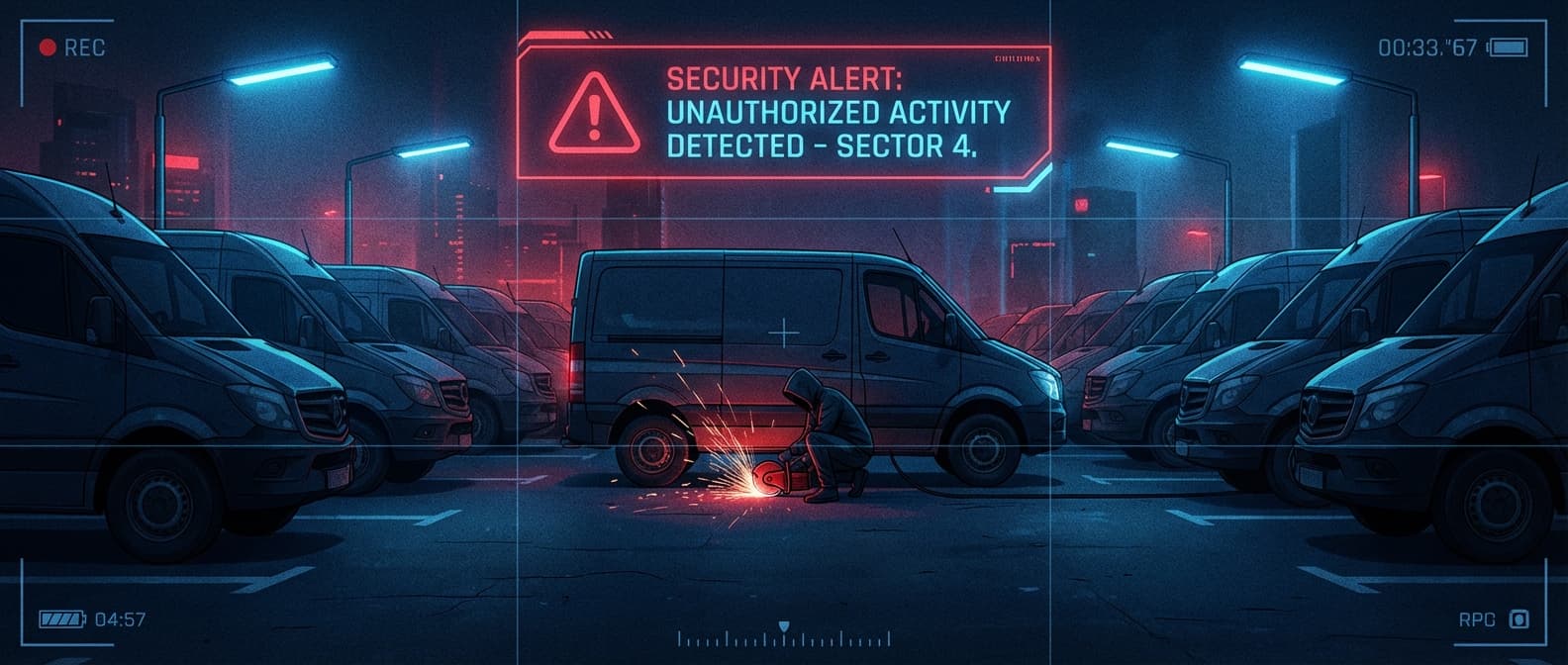
Catalytic Converter Theft Is Costing Fleets Thousands Per Vehicle
A thief with a battery-powered reciprocating saw can remove a catalytic converter in 30-60 seconds. In a fleet parking lot with 20 vans, that's 20 converters in under 30 minutes. At $2,000-$6,000 per incident (parts, labor, downtime, rental), a single overnight raid can cost a fleet $40,000-$120,000.
This isn't hypothetical. 300,000+ catalytic converter thefts occurred in 2023, up from 16,000 in 2018. That's nearly a 20x increase in five years. Insurance companies paid out $1.15 billion in converter theft claims in 2023 alone.
Fleet vehicles are disproportionately targeted because they park in large groups in predictable locations. A plumbing company in Houston lost 12 converters in 3 months ($36,000). A church van fleet in Atlanta had 8 vans hit in one night ($24,000). School bus fleets, Amazon delivery stations, municipal vehicle yards, and HVAC company lots all report routine converter theft.
This guide covers what fleet managers are actually doing to stop it, what works, what doesn't, and what it costs.
Why Catalytic Converters Get Stolen
Catalytic converters contain platinum, palladium, and rhodium. These metals catalyze the chemical reaction that reduces exhaust emissions. A stolen converter can contain $50-$1,000+ worth of precious metals, depending on the vehicle.
Most targeted fleet vehicles:
- Toyota Prius (hybrid = richer catalyst, highest scrap value per converter)
- Honda Accord / CR-V (easy undercarriage access)
- Ford F-150/F-250 (high ground clearance, converter easily accessible)
- Ford Econoline / Transit vans (fleet standard, high clearance)
- Chevrolet Express vans (fleet standard)
- Toyota Tacoma / Tundra (high ground clearance)
- Box trucks and delivery vans (tall enough to slide under without a jack)
Fleet vehicles are hit more than personal vehicles because:
- Predictable parking. Same lot, same time, every night.
- High ground clearance. Vans and trucks have enough clearance to slide under without jacking.
- Volume. One lot, 20 converters. Efficient for the thief.
- Slow detection. The theft happens at 2 AM. Nobody notices until the vehicle won't start at 7 AM.
The Full Cost of a Fleet Converter Theft
The converter itself is just the beginning.
| Cost Component | Range Per Vehicle |
|---|---|
| Catalytic converter (parts) | $1,000-$3,000 |
| Labor (removal, exhaust repair, installation) | $200-$500 |
| Exhaust system damage (pipe, O2 sensors, heat shields) | $500-$1,500 |
| Vehicle downtime (1-3 days minimum) | $200-$1,000/day |
| Rental or replacement vehicle | $100-$300/day |
| Insurance deductible (if claimed) | $500-$1,000 |
| Total per incident | $2,500-$7,300 |
Multiply by fleet size. If a 20-van fleet gets hit and loses 5 converters in one raid, that's $12,500-$36,500 in a single night.
Insurance ripple effect. After 2-3 claims, fleet insurance premiums increase 15-30%. Some insurers now add catalytic converter exclusions or require proof of prevention measures (shields, cameras) to continue coverage.
Hidden costs:
- Missed service appointments while vehicles are in the shop
- Customer complaints from delayed deliveries/service calls
- Employee morale (nobody wants their work van disabled every month)
- Time spent filing police reports, insurance claims, and coordinating repairs
What Actually Works: Fleet-Proven Prevention
After talking to fleet managers on r/FleetManagement, r/Truckers, and industry forums, a clear consensus emerges: layered prevention beats any single measure. Here's what the layers look like.
Layer 1: Catalytic Converter Shields ($150-$400/vehicle)
Physical shields are the most effective single measure. They bolt around the converter, adding 5-10 minutes to the theft attempt. Most thieves move on after 60 seconds of resistance.
| Shield Product | Material | Cost (parts + install) | Protection Level |
|---|---|---|---|
| Cat Shield | Aluminum | $150-$250 + $50-$100 install | Good (lightweight, visible deterrent) |
| Miller CAT | Steel cable | $200-$350 + $100 install | Very good (cable resists sawing) |
| CatClamp | Aircraft cable | $150-$200 + $50 install | Good (cable cage around converter) |
| CatStrap | High-temp strap | $50-$80 + DIY | Basic (lightweight, easy to install) |
| Custom welded cage | Steel plate | $300-$500 + $150 install | Excellent (hardest to defeat) |
Fleet pricing: Most shield manufacturers offer volume discounts for 10+ units. Cat Shield quotes fleet pricing directly. Budget $200-$350 per vehicle installed for a 20+ vehicle fleet.
Real fleet manager feedback:
"We have 40 service vans. Lost 9 converters in 6 months. Installed cat shields on all of them. Zero thefts in the 4 months since. Worth every penny of the $8,000 we spent." - r/FleetManagement
ROI math for a 20-van fleet:
- Shield cost: 20 vans x $300 = $6,000
- Cost of one converter theft: $2,500-$7,300
- Breakeven: Prevents 1-2 thefts
Shields pay for themselves after preventing a single incident.
Layer 2: Parking Strategy ($0)
Free and immediately implementable:
Back vehicles against walls or each other. If the underside isn't accessible, the converter can't be cut. Back all vans against the building wall, or park in pairs facing each other (bumper to bumper) with minimal gap.
Park low-clearance vehicles on the outside. Sedans and compact vehicles don't need jacking to access. Put them on the perimeter. Park high-clearance vans and trucks in the interior, surrounded by other vehicles.
Eliminate gaps. Park vehicles close together. Thieves need room to slide under and swing a saw. Tight parking makes this physically difficult.
Use well-lit areas. Move fleet parking under existing lights. If your lot has dark corners, park vehicles under lights and leave the dark areas empty.
"We rearranged our parking lot so all vans back up against the warehouse wall. Added two $30 motion-activated lights. Caught a crew on camera attempting, but they left because they couldn't get under the vans." - r/Truckers
Layer 3: Cameras and Lighting ($200-$2,000)
Cameras don't prevent theft in the moment, but they:
- Deter casual/opportunistic attempts
- Provide evidence for police (license plates, faces)
- Support insurance claims
- Enable prosecution (which deters repeat offenders)
Camera options for fleet lots:
| Option | Cost | Coverage |
|---|---|---|
| Ring Floodlight Camera | $180-$250 each | Single area |
| Reolink solar camera | $100-$200 each | Single area, no wiring |
| Full NVR system (4-8 cameras) | $500-$2,000 | Entire lot |
| Security company monitored | $50-$150/month | Entire lot + response |
Motion-activated lights ($30-$80 each) are the cheapest effective deterrent. A sudden flood of light at 2 AM sends most thieves running. Place them to cover all fleet parking areas.
Layer 4: VIN Etching and Marking ($25-$50/vehicle)
Etch the vehicle VIN onto the catalytic converter. This makes stolen converters traceable and harder to sell at scrap yards.
- Professional VIN etching: $25-$50/vehicle at most muffler shops
- DIY etching kit: $15-$30 (electric engraver from any hardware store)
- High-temp paint: Spray bright orange or yellow heat-resistant paint on the converter (makes it visibly marked)
- NICB free etching events: Check nicb.org for free catalytic converter etching events in your area
Several states (California, Texas, and others) now require scrap dealers to check for VIN markings and refuse marked converters without proof of ownership. This reduces the resale market for stolen converters in those states.
Layer 5: Overnight Movement Alerts ($11.99/vehicle/month)
This is where tracking technology fits into the picture. But it's important to be honest about what it does and doesn't do for converter theft specifically.
What tracking DOES:
- Alerts you if a fleet vehicle moves outside of business hours
- Geofence your parking lot and get instant notification of any vehicle movement
- If a thief jacks up a vehicle to access the converter, the movement may trigger an alert
- If a vehicle is stolen entirely (not just the converter), tracking locates it
What tracking DOESN'T do:
- Won't detect a thief who slides under a van, cuts the converter, and leaves without moving the vehicle significantly. This is the most common scenario for high-clearance vehicles.
- Won't prevent the theft itself.
- Won't alert you to undercarriage access specifically.
AirPinpoint for fleet overnight monitoring: Place an AirTag in each fleet vehicle. Set up a geofence around your fleet parking lot in AirPinpoint. Enable after-hours alerts (6 PM - 6 AM). Any vehicle movement outside business hours triggers an email or webhook notification.
Cost: $29 per AirTag (one-time) + $11.99/device/month on the Business plan.
For a 20-vehicle fleet: $580 in AirTags + $2,878/year = $3,458 first year.
Compare that to Samsara ($30-50/vehicle/month with 3-year contract): $7,200-$12,000/year for the same 20 vehicles, with the same limitation on converter-specific detection.
Where AirPinpoint genuinely shines for fleets: The converter theft protection is a bonus. The real value is fleet management during business hours. Know where every vehicle is. Track route efficiency. Verify that vehicles are at customer sites when scheduled. Get alerts when vehicles leave authorized service areas.
Converter theft geofencing is one feature of a fleet management platform that pays for itself through operational visibility.
The Layered Approach: Recommended Budget
| Measure | Cost (20-vehicle fleet) | What It Does |
|---|---|---|
| Parking strategy | $0 | Eliminates physical access |
| Motion lights (4 units) | $120-$320 | Deterrence |
| Cat shields (all vehicles) | $4,000-$7,000 | Physical barrier (5-10 min delay) |
| VIN etching | $500-$1,000 | Reduces resale market |
| Cameras (basic NVR) | $500-$2,000 | Evidence + deterrence |
| AirPinpoint fleet tracking | $3,458/year | Movement alerts + fleet management |
| Total Year 1 | $8,578-$13,778 |
Compare that to losing 5 converters: $12,500-$36,500 plus premium increases.
If budget is limited, prioritize in this order:
- Parking strategy (free)
- Cat shields (highest single-measure ROI)
- Motion lights (cheap deterrent)
- Fleet tracking (movement alerts + ongoing fleet value)
- Cameras (evidence for prosecution)
- VIN etching (reduces resale market)
Legal Landscape: What's Changing
Legislation is catching up to the epidemic:
Federal:
- PART Act (Preventing Auto Recycling Theft): Requires catalytic converter sellers to provide VIN and government ID. Creates federal penalties for trafficking stolen converters.
State-level (as of 2026):
- 38 states have passed or strengthened catalytic converter theft laws since 2021
- California: Felony charges with up to 3 years imprisonment. Scrap dealers must track all converter purchases.
- Texas: Felony charges for converter theft. Scrap yards must verify ownership and hold converters before processing.
- Many states: Requiring VIN marking on converters at time of sale, restricting cash purchases of converters at scrap yards, creating mandatory hold periods.
These laws reduce the end market for stolen converters. Combined with physical prevention and fleet monitoring, they're beginning to flatten the theft curve in states with strong enforcement.
The Bottom Line for Fleet Managers
Catalytic converter theft isn't going away while precious metal prices stay elevated. But fleet managers who implement layered prevention are seeing near-zero theft rates.
The formula that works:
- Rearrange your parking (tonight, free)
- Install cat shields (this month, $200-$350/vehicle)
- Add fleet tracking with overnight geofencing (ongoing, $12/vehicle/month with AirPinpoint)
- Document everything (VIN etch, cameras, police reports)
Cat shields stop the saw. Parking strategy removes access. Fleet tracking catches movement. And when your insurance company asks what prevention measures you have in place, you have a documented answer.
