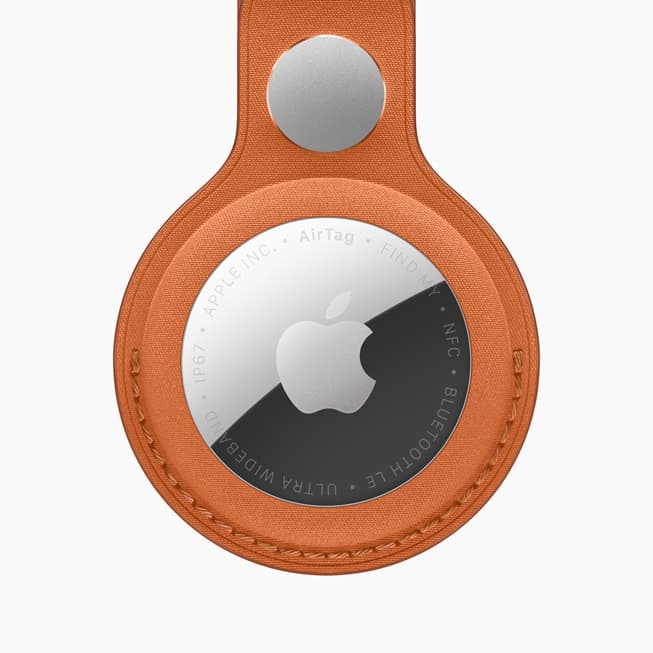
Apple officially launched the AirTag 2 on January 26, 2026, marking the first hardware update to its popular item tracker since the original debuted in 2021. After nearly five years, businesses that rely on AirTags for asset tracking finally have new hardware to evaluate. Here's what the AirTag 2 brings to the table and what it means for commercial tracking use cases.
What's New in AirTag 2
Extended Precision Finding Range
The headline improvement is the second-generation Ultra Wideband (UWB) chip, the same one powering the iPhone 17 lineup. This extends Precision Finding range by approximately 50%, from roughly 10-15 meters to around 60 meters in optimal conditions.
For businesses tracking assets in warehouses, job sites, or large facilities, this means fewer "last known location" frustrations when an AirTag is just out of range.
50% Louder Speaker
The new speaker is significantly louder, making it easier to locate tagged items by sound. Apple positioned this as an anti-stalking measure, but it's equally valuable for businesses trying to find misplaced equipment in noisy environments like construction sites or manufacturing floors.
Tamper-Proof Design

Our early teardown reveals Apple has completely redesigned the internal assembly. The speaker is now permanently bonded to the housing—it no longer comes out. This directly addresses one of the original AirTag's biggest security flaws, where bad actors could disable the speaker to prevent detection during unauthorized tracking.

Additional design changes we've observed:
- New battery supplier: Apple has switched from Panasonic to Duracell for the included CR2032
- Enhanced adhesion: Significantly more adhesive throughout the assembly makes unauthorized disassembly much harder
- Thinner PCB: The main circuit board is approximately half the thickness of the original, likely accommodating the upgraded UWB chip while maintaining the same form factor
Share Item Location with Airlines and Teams
Apple expanded the Share Item Location feature to work with over 50 airlines for luggage tracking. More importantly for businesses, you can now share an item's location with up to five other people through the Find My app.
This addresses one of the biggest pain points for business users: the single Apple ID limitation. Teams can now share visibility into tracked assets without passing around login credentials.
Precision Finding on Apple Watch
For the first time, Precision Finding works on Apple Watch Series 9 and later. Field workers can locate tagged equipment directly from their wrist without pulling out their phone.
What Hasn't Changed
The 32 AirTag Limit Per Apple ID
Apple still caps each Apple ID at 32 AirTags. For businesses tracking more than 32 assets, this remains a significant limitation requiring multiple Apple IDs or third-party management platforms.
No Real-Time GPS Tracking
AirTags still rely on the Find My network for location updates, meaning they only report when an Apple device passes nearby. There's no cellular radio or true GPS for continuous, real-time tracking.
No Historical Location Data
AirTags only show current (or last known) position. Apple doesn't provide location history, which many businesses need for route optimization, compliance documentation, or loss investigation.
Battery Life Unchanged
The CR2032 battery still lasts "more than a year" according to Apple. No improvement here despite five years of development.
No Additional Sensors
Temperature, humidity, shock detection: AirTag 2 has none of these. For industries like cold chain logistics or sensitive equipment transport, dedicated tracking hardware remains necessary.
What This Means for Business Asset Tracking
The AirTag 2 is a meaningful upgrade for personal item tracking, but the improvements don't fundamentally change the calculus for business users.
Good news:
- Extended range makes finding assets in large spaces more reliable
- Item sharing reduces the friction of team-based tracking
- Apple Watch support helps field workers stay productive
Unchanged challenges:
- 32-tag limit still requires workarounds for fleet-scale deployments
- No historical data for analytics or compliance
- Network-dependent updates aren't suitable for time-critical tracking
- No API access for integration with business systems
How AirPinpoint Solves These Limitations
AirPinpoint was built specifically to bridge the gap between AirTag's consumer-focused design and enterprise tracking needs:
- Unlimited AirTags: Track hundreds or thousands of AirTags across your organization
- Historical Location Data: Full location history with timestamps for every asset
- Team Access: Multi-user dashboard without sharing Apple IDs
- Geofencing Alerts: Get notified when assets enter or leave designated areas
- API Integration: Connect tracking data to your existing business systems via Zapier or direct API
The AirTag 2's improvements make the underlying hardware more capable. Platforms like AirPinpoint make that hardware work at business scale.
Should You Upgrade to AirTag 2?
For businesses already using AirTags through AirPinpoint or similar platforms, the AirTag 2 offers incremental benefits:
- Worth upgrading if your use case benefits from extended Precision Finding range (large facilities, outdoor sites)
- Worth upgrading if you need the louder speaker for noisy environments
- No rush to upgrade if your current AirTags are working fine for basic location tracking
The AirTag 2 maintains the same $29 price point ($99 for a four-pack), so the cost of upgrading is purely the hardware, not a change in your tracking workflow.
The Bottom Line
AirTag 2 is the hardware refresh businesses have been waiting for, but it's an evolution, not a revolution. Apple improved the things that make AirTags useful (range, sound, sharing) without addressing the fundamental limitations that push businesses toward enterprise tracking platforms.
For organizations that need more than 32 tracked assets, historical data, or integration with business systems, the AirTag 2 is still just one piece of the puzzle. The combination of improved AirTag hardware and purpose-built management platforms like AirPinpoint remains the most cost-effective approach to business asset tracking.
Ready to track your assets at scale? Start your free trial and see how AirPinpoint transforms AirTags into an enterprise-ready tracking solution.
