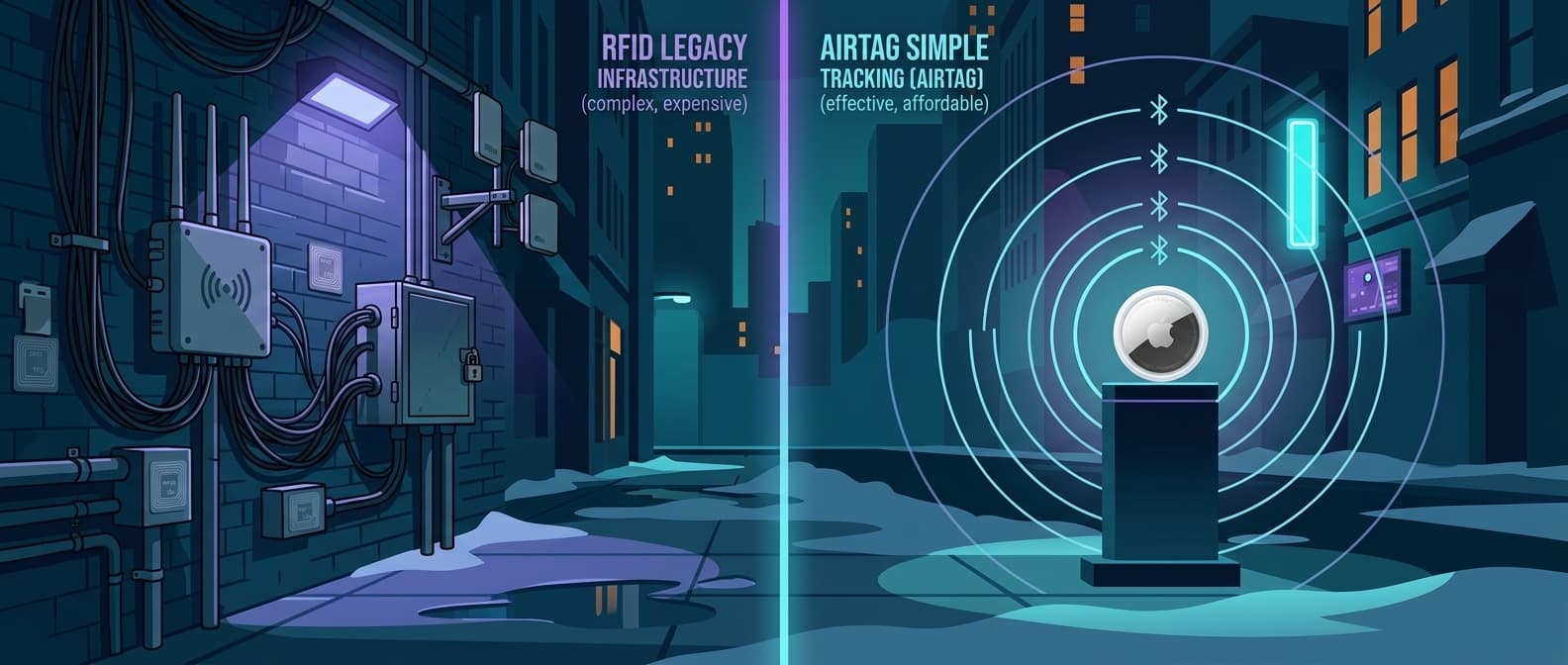
Why RFID Is Overkill for Most Asset Tracking
An RFID tag costs $0.10. The system to read it costs $50,000.
That gap between tag price and total deployment cost is the most misunderstood number in asset tracking. RFID vendors lead with the tag price because it sounds precise. Ten cents per asset!
But tags don't read themselves. They need readers ($1,000-$3,000 each), antennas ($100-$300 each), cabling, middleware ($5,000-$20,000), software integration, and consulting that routinely accounts for 50-80% of total project cost. A mid-size RFID deployment for 500 assets across two facilities runs $75,000-$150,000 before anyone scans a single tag.
An AirTag 2 costs $29, connects to a network of 1B+ Apple devices, and tells you where your asset is right now, outdoors or indoors, with zero infrastructure. For 500 assets, that's $14,500 in hardware and $0 in infrastructure.
RFID is not bad technology. It is excellent technology for a specific set of problems. Most companies searching for "RFID asset tracking" don't have those problems. They have a different question entirely, and RFID is the wrong answer to it.
Two Different Questions
RFID solves: "What passed through this doorway?"
BLE/Find My solves: "Where is this thing right now?"
These sound similar. They are fundamentally different.
RFID reads tags as they cross a fixed reader, like a toll booth. It tells you an asset entered or exited a zone at a specific time. That's powerful in a warehouse picking line, a retail checkout, or a manufacturing floor where assets move through predictable chokepoints.
Most asset tracking needs aren't about chokepoints. A construction company wants to know which job site their excavator is at. A logistics firm wants to find a specific pallet in a 200,000 sq ft yard. A healthcare org wants to locate a wheelchair somewhere in a 12-building campus.
None of these problems involve doorways. They involve open, unpredictable spaces where assets move freely.
RFID can't answer "where is it right now?" without blanketing an entire space with readers. BLE tracking on the Find My network answers it by default, because the network is already everywhere.
The Hidden Cost of RFID
RFID sticker shock comes in layers. Each layer sounds reasonable in isolation. Together, they compound.
Layer 1: Hardware
| Component | Unit Cost | Qty (2 facilities) | Total |
|---|---|---|---|
| Passive UHF tags | $0.50-$5.00 | 500 | $250-$2,500 |
| Fixed readers | $1,500-$3,000 | 8 | $12,000-$24,000 |
| Antennas (2-4 per reader) | $100-$300 | 24 | $2,400-$7,200 |
| Handheld readers | $1,000-$4,500 | 4 | $4,000-$18,000 |
| Cabling & mounting | $200-$500/reader | 8 | $1,600-$4,000 |
| Hardware subtotal | $20,250-$55,700 |
Layer 2: Software and Integration
Middleware to filter, route, and process tag reads: $5,000-$20,000. Integration with your ERP, WMS, or inventory system: $10,000-$50,000. Software licenses: $5,000-$50,000 upfront, plus 15-25% annual maintenance.
According to Inbound Logistics, consulting and professional services represent the largest long-term expense in RFID projects, reaching up to 80% of total cost in some cases.
Layer 3: Ongoing
Annual maintenance runs 10-15% of system cost. Active and semi-passive tags need battery replacements every 3-5 years. Reader firmware updates, antenna recalibration, tag replacement for damaged units. Budget $15,000-$35,000 per year to keep it running.
Total first-year cost for 500 assets across 2 sites: $75,000-$200,000+.
Compare that to a BLE/Find My deployment:
| Component | Unit Cost | Qty | Total |
|---|---|---|---|
| AirTag 2 | $29 | 500 | $14,500 |
| Airpinpoint subscription | $5.99-$11.99/tag/mo | 500 | $35,940-$71,940/yr |
| Fixed infrastructure | $0 | 0 | $0 |
| Integration/consulting | $0 | 0 | $0 |
| First-year total | $50,440-$86,440 |
The BLE option costs less in year one, with no infrastructure to maintain, no readers to recalibrate, and no middleware to update. By year two, the gap widens because RFID maintenance compounds while BLE costs stay flat.
Where RFID Actually Fails
Beyond cost, RFID has physics problems that don't show up in vendor demos.
Metal kills read rates. Metal surfaces reflect UHF radio waves, detuning tag antennas and reducing read range by 50% or more. Construction equipment, tools, vehicles, metal shelving, shipping containers: if your assets are made of metal (and most tracked assets are), standard RFID tags underperform. Metal-mount tags exist but cost $5-$50 each instead of $0.10, eliminating the cost advantage.
Liquids absorb signal. Water and water-based liquids absorb RF energy at UHF frequencies. Tracking beverages, chemicals, medical supplies, or any liquid-containing asset requires specialized tags and careful reader placement.
Passive range caps at 3-10 meters in practice. Vendor specs claim 12-15 meters. Real-world reads with passive UHF tags in non-ideal environments (metal nearby, multiple tags, ambient interference) land at 3-10 meters. Fine for a doorway portal. Useless for tracking across a construction yard, parking lot, or multi-building campus.
No outdoor tracking. RFID requires fixed readers at specific locations. Outdoors, that means weatherproof enclosures, power runs, network connections, and mounting hardware at every coverage point. Tracking assets across job sites, in transit, or in the field becomes a civil engineering project, not an IT deployment.
AirTags face none of these constraints. BLE signals penetrate metal containers (with some attenuation). The Find My network works outdoors because the "readers" are iPhones and iPads carried by over a billion people. No fixed infrastructure, no power runs, no weatherproofing.
When RFID Makes Sense
RFID earns its cost in three scenarios.
1. High-volume chokepoint scanning. Retail stores scanning 10,000+ items through checkout or receiving. Warehouses processing hundreds of pallets per hour through dock doors. Manufacturing lines tracking work-in-progress through stations. If you need to read 50+ tags simultaneously as they pass a fixed point, RFID's batch-read capability is unmatched. BLE can't do this.
2. Sub-meter indoor positioning. Active RFID with dense reader arrays can locate assets within 1-3 meters inside a controlled facility. Hospital RTLS tracking infusion pumps across floors. Cleanroom tool tracking in semiconductor fabs. If you need room-level indoor accuracy and will invest in the reader infrastructure, RFID delivers.
3. Fully automated inventory counts. Retail apparel stores using RFID to count every item on every shelf without human intervention. RFID can scan an entire store's inventory in hours instead of days. 99%+ read accuracy at close range justifies the tag cost when you're counting tens of thousands of SKUs.
The pattern: these are all indoor, high-density, fixed-infrastructure environments. The assets don't leave the building. The read points are predictable. The volume justifies the investment.
When BLE/Find My Wins
For everything else, BLE tracking on the Find My network is the better tool.
Field equipment. Excavators, generators, compressors, trailers. These move between job sites. RFID would require readers at every site entrance (plus power and networking at each). An AirTag attached to the equipment reports its location anywhere there's an iPhone nearby, which in any metro or suburban area is everywhere.
Fleet and vehicle tracking. Company trucks, service vans, rental vehicles. BLE trackers report location continuously without OBD ports, wiring, or cellular data plans. Airpinpoint provides geofence alerts when vehicles enter or leave designated zones.
Multi-site inventory. Tools, laptops, medical devices that move between buildings or campuses. RFID only works at instrumented doorways. BLE tracking shows you which building the asset is in right now, even if it was hand-carried through a back door.
Outdoor storage. Lumber yards, equipment yards, container depots. Installing RFID readers outdoors is expensive and maintenance-heavy. The Find My network covers open spaces by default.
Assets in transit. Pallets on trucks, equipment being shipped between sites, returnable containers. RFID loses visibility the moment an asset leaves reader range. BLE trackers report location throughout the journey.
The Decision Matrix
| Factor | Choose RFID | Choose BLE/Find My |
|---|---|---|
| Primary question | "What crossed this point?" | "Where is this right now?" |
| Environment | Indoor, controlled | Indoor, outdoor, or mixed |
| Asset count | 10,000+ items, same location | Any count, any location |
| Scan speed needed | 50+ items/second | Individual location queries |
| Infrastructure budget | $50K+ available | Minimal or zero |
| Asset material | Non-metal, non-liquid | Any material |
| IT team | Dedicated RFID admin | No specialized staff needed |
| Timeline | 3-6 month deployment | Same-day deployment |
The AirTag 2 Advantage
The AirTag 2, released January 2026, closed the remaining gaps that made earlier BLE trackers impractical for business use.
Precision Finding that reaches 50 percent farther. The original AirTag's UWB range was too short to be much help in a large facility. Apple says the AirTag 2 guides you to a lost item from up to 50 percent farther away, roughly 1.5x the original's Precision Finding range, which is enough to pick an asset out of a warehouse aisle or a parking lot. Apple has never published a meter figure for either generation, so walk-test it in your own space.
A much louder speaker. Apple rates it 50 percent louder and audible from up to 2x farther, without publishing a dB figure. Cult of Mac and Macworld measured the original at 66dB, inaudible in noisy environments, and AirTag 2 between 85 and 87dB, which is enough to hear on a construction site or in a busy warehouse.
$29, no subscription at the hardware level. The tag itself has no recurring cost. Airpinpoint adds the business layer (dashboard, geofences, history, team access, API) starting at $5.99/tag/month. For a 100-asset deployment, that's $2,900 in hardware plus $599-$1,199/month for full fleet management. An equivalent RFID system would cost $30,000-$60,000 upfront before software.
Same-day deployment. Peel the backing off an AirTag holder. Stick it to the asset. Open the Airpinpoint dashboard. You're tracking. No readers to mount, no antennas to aim, no middleware to configure, no consultants to hire.
The Bottom Line
RFID vendors are marketing aggressively right now, and searches for "RFID asset tracking" are surging. That marketing works because RFID sounds precise, enterprise-grade, and sophisticated. It is all three.
It's also $50,000-$200,000 for a mid-size deployment, limited to indoor fixed-reader zones, degraded by the metal and liquid that most real assets contain, and requires dedicated IT staff to maintain.
For the 80% of businesses whose real question is "where are my assets right now," BLE tracking on the Find My network delivers better answers at a fraction of the cost. Not because it's more sophisticated. Because it solves the right problem.
If you're evaluating RFID, ask yourself one question: do I need to know what passes through a specific doorway, or do I need to know where my assets are? If it's the second one, you don't need RFID. You need Airpinpoint.
Apple stops at 32 AirTags per account
Airpinpoint tracks unlimited tags in one dashboard, with location updates about every 5 minutes, geofence alerts, and a REST API, from $11.99 per tag per month.
Free to start. Works with the AirTags you already own. 6,700+ tags under management.
