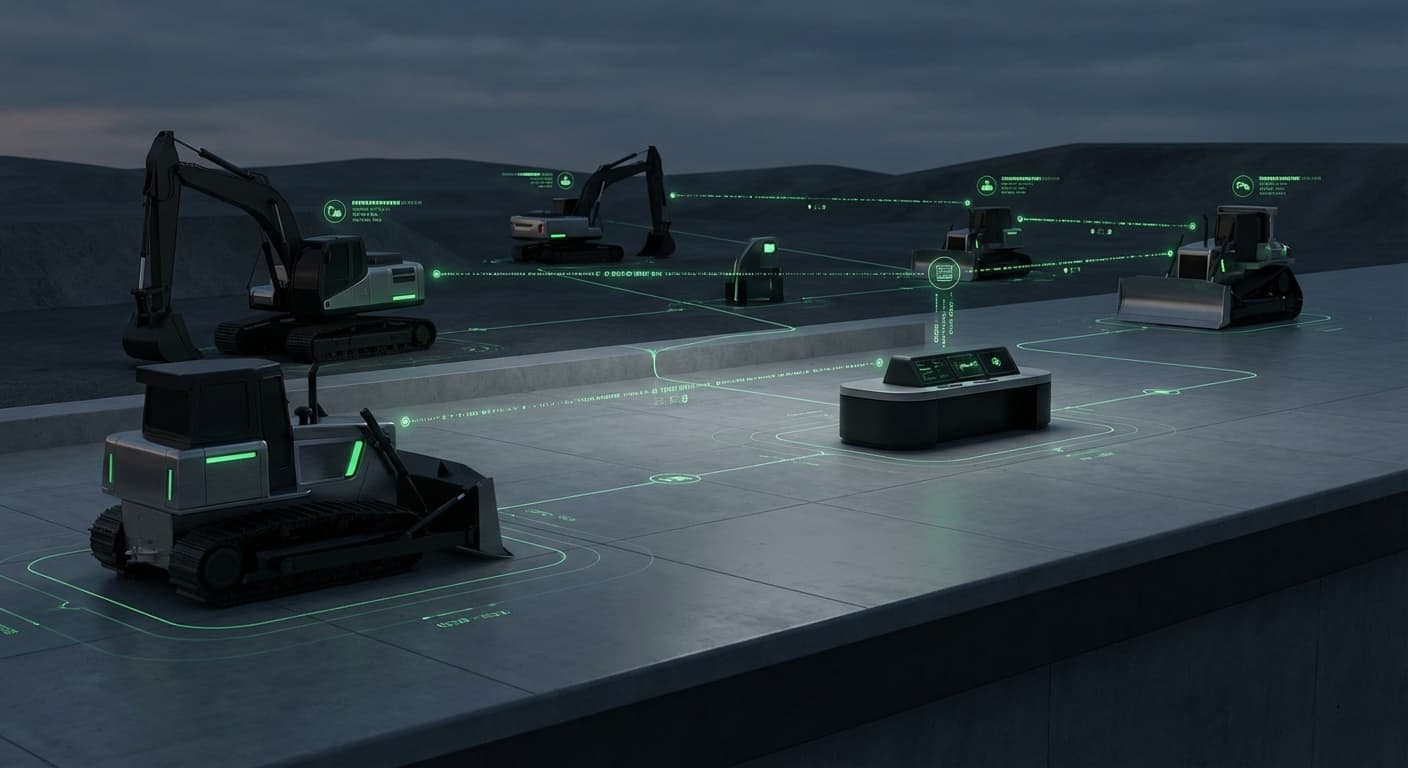
On December 22, 2025, John Deere announced it had entered into an agreement to acquire Tenna, the construction equipment tracking platform based in New Hope, Pennsylvania. The deal value was not disclosed. The transaction is expected to close in February 2026, pending regulatory approval.
This is one of the largest moves an OEM has made into the third-party tracking space, and it signals a fundamental shift in how the construction industry thinks about equipment visibility.
If you run a mixed fleet, this acquisition should change how you evaluate tracking solutions.
What Happened
Tenna was founded in 2015 and built a reputation as the go-to tracking platform for construction companies running mixed fleets. The company's growth trajectory speaks for itself:
- 740% revenue growth from 2021 to 2024, reaching $15 million in annual revenue
- Ranked on the Inc. 5000 list four consecutive years (No. 552 in 2025, No. 162 in 2024, No. 284 in 2023)
- 3,400% combined growth over four years
- 450 customers across construction, served by 136-141 employees across three continents
Their platform tracked everything from Cat excavators to JLG lifts to unmarked job boxes -- regardless of manufacturer -- using GPS, Bluetooth Low Energy (BLE), LoRa, and QR code tracking technologies.
John Deere saw enough value in that capability to buy the entire company. Deere has said Tenna will continue to operate as an independent business, marketed directly to construction customers under the Tenna brand name. The stated focus: "scaling and growing the business through its proven mixed-fleet customer-focused business model."
This is not Deere's first acquisition play. In 2017, they paid EUR 4.357 billion ($5.2 billion) for the Wirtgen Group, making Deere the third-largest construction equipment provider globally. They also acquired majority ownership of Kreisel Electric for battery technology. The pattern is clear: portfolio expansion, electrification, and now digital fleet management.
Why This Matters for the Industry
The construction equipment telematics market is projected to reach $1.498 billion by 2026, growing at 17.2% CAGR from $676 million in 2021, according to MarketsandMarkets. Deere acquiring Tenna validates what equipment managers have known for years: tracking isn't optional anymore. It's infrastructure.
Three things stand out about this deal:
OEMs now view tracking data as a competitive asset. Deere isn't buying Tenna for the hardware revenue. They want the data layer -- utilization patterns, movement history, idle time analytics -- that sits on top of location tracking. Tenna customers have documented serious ROI: GS Construction saved over $1 million per year in fuel, Nor-Cal Pipeline recovered $500,000 in stolen assets, and Royal Electric reclaimed $50,000-$75,000 per month in revenue through utilization tracking.
Third-party tracking platforms are acquisition targets. If you're building your operations around a tracking vendor, you need to consider what happens when that vendor gets acquired. Tenna customers woke up to find their vendor is now owned by the same company that makes the equipment they're tracking. That creates conflicts of interest.
The mixed-fleet problem isn't going away. The average contractor operates equipment from five or more manufacturers. No single OEM controls enough market share to offer a complete tracking solution through their own telematics. Caterpillar holds 16.8% global market share, Komatsu 10.4%, and John Deere just 5.4%. That's exactly why Tenna grew so fast, and exactly why Deere wanted them.
The Mixed Fleet Problem Gets Worse
Here's the core tension: Tenna's value was its independence. A superintendent could log in and see every asset across every brand on one screen. The platform integrated with major OEM telematics systems through the ISO 15143-3:2020 standard (formerly AEMP 2.0), pulling data from Caterpillar (VisionLink), Komatsu (KOMTRAX), John Deere (JDLink), Takeuchi, JCB LiveLink, Vermeer, Develon, Liebherr, and TESMEC.
That neutrality is what drove adoption. Under Deere ownership, it is in question.
Will Deere maintain full feature parity for Caterpillar and Komatsu equipment tracked through Tenna? Will competitors' data flow through Deere's infrastructure? Will Tenna's pricing stay the same for non-Deere fleets, or will Deere equipment get preferential treatment?
Deere has publicly committed to maintaining Tenna as a mixed-fleet platform. As Sustainable Construction Review noted, the acquisition "signals a clear shift in John Deere's construction strategy, positioning the company as a technology provider for entire jobsite ecosystems rather than limiting digital tools to Deere-only machines."
But history suggests integration pressure builds over time. Features get prioritized for the parent brand. Competitor support becomes a lower priority. Pricing shifts to incentivize the parent's hardware.
With John Deere holding only 5.4% global construction equipment market share, maintaining neutrality is strategically essential -- most contractors operate Caterpillar or Komatsu equipment. But strategic necessity and organizational reality don't always align.
What Tenna's Hardware Looks Like
Tenna's technology spans multiple tracking methods, which is what made them attractive to Deere:
GPS tracking for fleet vehicles, heavy iron, and mid-sized equipment. Military-grade satellite positioning that works almost everywhere outdoors.
BLE tracking via the TennaBLE Steel Puck SP2 -- a next-generation beacon with IP68 and IP69k ratings (protection against dirt, water immersion, and high-pressure washdowns), a welded steel outer casing, and up to 3 years of battery life. Designed for trench boxes, concrete forms, buckets, and blades.
LoRa technology for long-range tracking without cellular coverage, enabling private IoT networks at worksites.
QR codes for durable, scannable inventory labels on any asset.
TennaCANbus for detailed engine diagnostics and TennaCAM 2.0 for dual-facing cameras providing 360-degree views around heavy machinery.
What Construction Teams Should Do Now
If you're currently using Tenna, there's no reason to panic. The platform will likely continue operating normally through 2026 and beyond. But this is the right time to evaluate your dependencies.
Audit Your Current Tracking Coverage
Document exactly what you're tracking, how many assets, across how many sites, and what data you actually use. Industry data shows typical construction equipment utilization rates sit at just 50-60%, meaning 40-50% idle time. Cost of idle time can drive operational costs up by 30%. If you're only tracking heavy iron and missing portable equipment, small tools, and non-powered assets, you're flying blind on a significant portion of your capital.
Evaluate Vendor Independence
Ask a direct question: if your tracking vendor were acquired tomorrow by one of your equipment OEMs, would you be comfortable with that arrangement? Wall Street analysts have weighed in -- Truist Securities maintained a $612 price target for Deere, and DA Davidson targeted $580, both viewing the acquisition as part of Deere's aggressive technology diversification. Analyst sentiment is positive for Deere shareholders. Whether it's positive for Tenna customers running Cat and Komatsu fleets remains to be seen.
Consider the Total Fleet, Not Just Heavy Iron
OEM telematics systems (JDLink, Cat Product Link, Komatsu KOMTRAX) track powered equipment with built-in hardware. KOMTRAX has been standardized in Komatsu machines since 2007 and is 100% free for the life of the machine. Cat recently relaunched VisionLink as a free fleet management solution with 1.5 million+ connected assets.
But construction job sites are full of assets that don't have engines: generators, light towers, portable toilets, scaffolding, form systems, job boxes, and hand tools. These assets represent significant capital, and they're the ones most likely to walk off a site. Construction equipment theft costs the industry $300 million to $1 billion annually, with only a 21-25% recovery rate.
Any tracking solution you adopt should cover the full spectrum, from a 100-ton excavator to a $200 laser level.
Test Before You Commit
Deploy tracking on a representative subset of your fleet -- maybe 20-30 assets across two or three job sites -- before signing a multi-year contract with any vendor. Evaluate real-world update frequency, battery life, alert reliability, and how well the platform handles assets that move between sites.
The Cost Reality for Small and Mid-Size Contractors
Enterprise tracking platforms like Tenna carry enterprise pricing. For small to mid-size contractors, the typical cost breakdown looks like this:
- Hardware: $100-400 per GPS device
- Monthly subscription: $25-50 per tracked asset
- Implementation: $2,000-10,000+ for setup and training
- Contracts: 2-3 year minimums are common
For a contractor with 50 assets, that's $15,000-30,000 per year before you've prevented a single theft or found a single misplaced generator. Post-acquisition, expect Tenna's pricing to stay enterprise-focused as Deere integrates it into their broader technology stack.
What Enterprise GPS Gives You (and What You Can Skip)
Enterprise GPS tracking provides capabilities that many small fleets don't actually need:
- Real-time continuous tracking: GPS reports every few seconds; Bluetooth updates when Apple devices pass nearby
- Engine diagnostics: OBD/CAN bus integration for maintenance data
- Compliance reporting: ELD and DVIR capabilities for regulated CDL fleets
If you run CDL vehicles with DOT compliance requirements, you need GPS telematics. But if you're tracking trailers, generators, compressors, hand tools, and jobsite equipment, you don't need any of that.
AirPinpoint: Built for Mixed Fleets, No OEM Strings Attached
AirPinpoint is purpose-built for the problem that Deere's acquisition of Tenna just made worse: tracking every asset you own, regardless of manufacturer, without depending on any single OEM.
How It Works
AirPinpoint uses the Find My network -- over one billion active Apple devices worldwide -- to locate tracked assets. You attach a tracking tag to any piece of equipment, and it reports its location whenever an Apple device passes within Bluetooth range. No cellular plan. No hardwired installation. No OEM integration required.
For construction sites in urban and suburban areas, where Apple device density is high, this means location updates every few minutes. For remote sites, updates come less frequently but still provide daily position data in most cases.
What You Get
- Brand-agnostic tracking. Deere, Cat, Komatsu, Volvo, JLG, Genie -- it does not matter. If you can stick a tag on it, AirPinpoint tracks it.
- Geofence alerts. Draw polygons around your job sites and yards. Get notified when equipment enters or exits.
- Location history. Full historical tracking data, exportable for compliance, insurance claims, or operational analysis.
- No monthly cellular fees. AirTag-based tracking uses the Find My network at no per-device communication cost.
- Deploy in minutes. Peel, stick, done. No technician visit, no wiring harness, no downtime.
Cost Comparison
OEM telematics and dedicated GPS trackers typically run $15-40 per device per month for cellular connectivity alone, before platform fees. For a 200-asset fleet, that's $36,000 to $96,000 per year in tracking costs.
AirPinpoint's pricing starts at a fraction of that, with no per-device cellular fees. Check current pricing for details.
The math becomes even more compelling when you factor in deployment cost. Installing a hardwired GPS tracker on a piece of heavy equipment takes 1-2 hours of technician time. Attaching a tracking tag takes 30 seconds.
ConExpo 2026: Tracking Takes Center Stage
ConExpo-Con/AGG 2026 runs March 3-7 in Las Vegas, with 139,000+ expected attendees and over 2,000 exhibitors across 2.9 million square feet. Equipment tracking will be one of the dominant themes.
Expect to see:
- Komatsu unveiling Smart Construction Dashboard mobile for planning, tracking, and precise digging, alongside their My Komatsu enterprise platform with AI and data analytics.
- Caterpillar expanding VisionLink as a free, ISO-compliant mixed-fleet management solution.
- Deere positioning the Tenna integration with their existing JDLink ecosystem as the most comprehensive OEM-plus-mixed-fleet solution available.
- AI-powered fleet intelligence -- Bobcat's Service.AI for instant diagnostics, HCSS Copilot AI embedded in workflows, and predictive maintenance platforms claiming 45% reductions in equipment downtime.
The underlying message from every booth will be the same: if you're not tracking your equipment digitally, you're operating blind.
The question is whether you want that visibility controlled by the same companies selling you the equipment, or whether you want an independent platform that works for your entire fleet.
The Bottom Line
John Deere acquiring Tenna is a validation event for the entire construction equipment tracking industry. It confirms that location intelligence is now a core part of the equipment lifecycle, not an aftermarket add-on.
But it also highlights a risk that construction companies need to take seriously: OEM lock-in through software acquisitions. The same company that sells you an excavator now controls the tracking platform that monitors your competitor's excavator sitting next to it.
For teams running mixed fleets -- which is nearly everyone -- brand-agnostic tracking has never been more important. Solutions that work across every piece of equipment on your site, with no dependency on any single manufacturer, are the safest long-term bet.
Start tracking your full fleet with AirPinpoint -- no OEM lock-in, no SIM cards or data plans, deploy in minutes.
