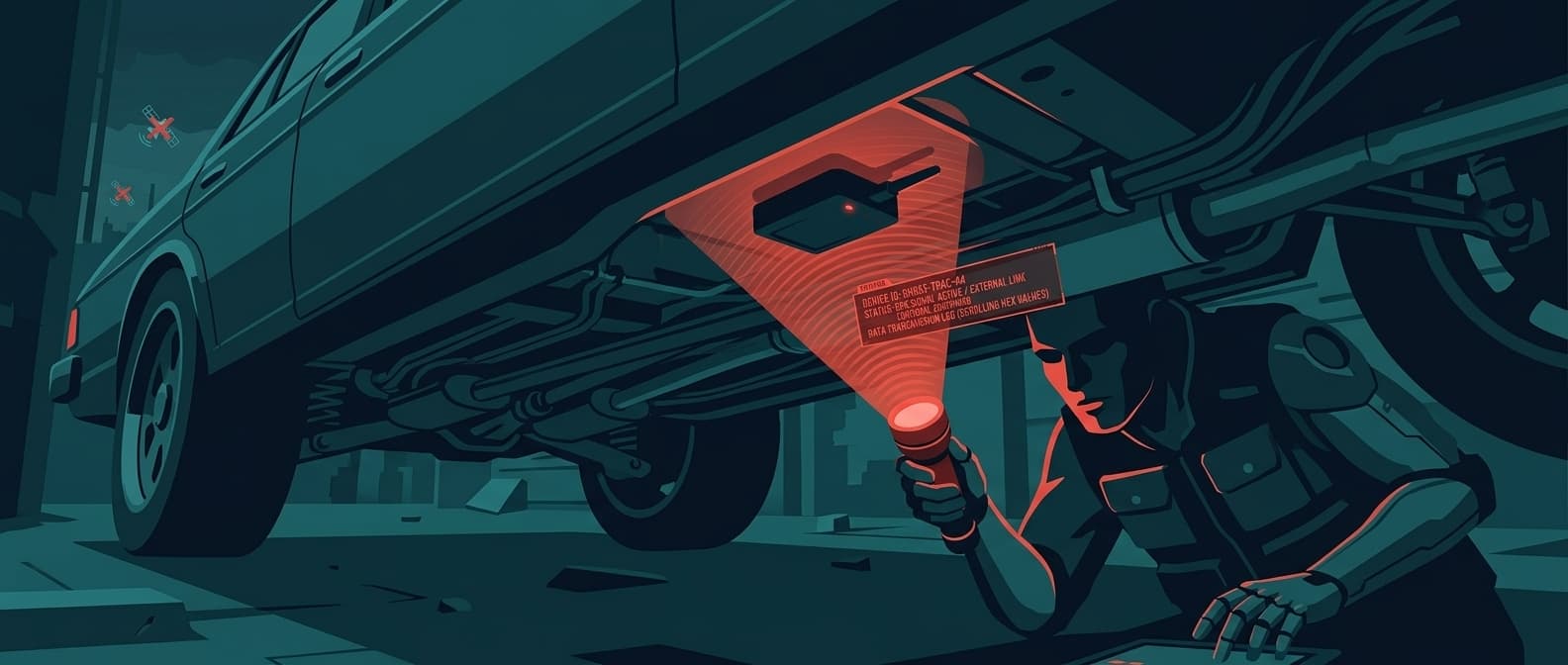
How to Find a Hidden GPS Tracker on Your Car
If you think someone is tracking your car, you can check it yourself in under an hour with a phone and a flashlight. Most trackers fall into four types, and each one is found a different way, so the trick is matching the search method to the kind of device you're looking for.
Signs Your Car Is Being Tracked
Before you start tearing panels off, look for the patterns that actually point to a tracker:
- Someone knows where you've been without you telling them, repeatedly and specifically.
- The same car keeps showing up behind you across different trips and routes.
- An unfamiliar app or notification appears, like "Item Detected Near You" on an iPhone or an unknown tracker alert on Android.
- New wiring, zip ties, or electrical tape under the dash or around the OBD-II port that wasn't there before.
- A small box with a magnet in a wheel well, under a bumper, or on the undercarriage.
- Your dashboard battery drains faster or a parasitic draw appears (hardwired trackers pull from the 12V system).
- A recent trigger: a breakup, a sale or service visit, a repossession risk, or the car being in someone else's hands.
If two or more of these fit, run the checklist below. Start with the 60-second phone scan, because it rules out the most common modern tracker in under a minute.
The 60-Second Phone Scan (Do This First)
Bluetooth trackers like AirTags are now the most common thing people hide on a car, and your phone can find them for free. No app purchase, no hardware.
On iPhone (iOS 14.5 or later):
- Open the Find My app.
- Tap the Items tab.
- Scroll down and tap Items Detected Near You (older versions call this "Items That Can Track You").
- Any unknown AirTag or Find My accessory moving with you shows up here. Tap it to play a sound and get directions to it.
Since iOS 17.5, this also catches third-party Find My network trackers, not just Apple AirTags.
On Android (Android 6.0+ with Google Play services):
- Go to Settings, then Safety & Emergency, then Unknown Tracker Alerts.
- Make sure the feature is on.
- Tap Scan to run a manual Bluetooth sweep.
This catches AirTags, Samsung SmartTags, Tile, Chipolo, and anything else following the DULT (Detecting Unwanted Location Trackers) standard.
Then run a free BLE scanner app. Some trackers don't follow the DULT standard and won't trigger the built-in alerts. A free Bluetooth scanner like nRF Connect or BLE Scanner lists every Bluetooth device broadcasting near you. Two technical details make this far more useful than it looks:
- Signal strength tells you distance. Each device shows an RSSI value in dBm. A very strong signal, roughly anything stronger than -50 dBm, means the source is within about a meter of your phone. Walk the scanner around the cabin and trunk, watch the number climb, and you've narrowed the tag to a spot you can reach.
- Apple beacons advertise under company code 0x004C. Apple Find My devices broadcast manufacturer data tagged with Apple's Bluetooth company identifier, 0x004C (76 in decimal). Scanner apps that decode manufacturer data will label these as Apple, which separates a hidden tag from the dozen phones and earbuds also showing up in a parking lot.
The skill here is finding the one device that's always present when you scan inside your car and absent when you scan a block away.
Where Trackers Hide (Ranked)
Worked from how trackers are actually installed (fast and external for battery units, tucked and wired for professional ones), here is where to look, most likely first:
- OBD-II port. Under the dash on the driver's side, within about two feet of the steering column. A plug-in tracker sits right in the port and is the single fastest thing to install. Check here first.
- Wheel wells. The number-one spot for magnetic battery trackers. Run your hand along the inner lip of all four wells, feeling for a box stuck to the metal fender. Use a flashlight and an inspection mirror for the parts you can't reach.
- Under bumpers and the undercarriage. Feel into the gap between the plastic bumper cover and the metal beam, front and rear. Underneath, check the frame rails, around the exhaust, and near the fuel tank. Undercarriage units are usually in a black weatherproof case about the size of a deck of cards.
- Spare-tire well. Lift the spare or the access panel and check the well and surrounding cavities. It's rarely opened and has plenty of room.
- Inside seats, trim, and panels. Slide each seat fully forward and back, checking underneath at both positions. Pry interior trim and door panels (clips plus a few screws) if you still suspect one and haven't found it. Also check behind the lower dash panel, behind the glove box, inside the center console, behind the rearview mirror, and in the trunk side walls near the taillights.
For the engine bay: open the fuse box and look for anything that isn't factory (some trackers mimic relays), check around the battery for aftermarket wiring, and look behind the front grille, where trackers get wedged for a better cellular signal.
Which Method Finds Which Tracker
The biggest mistake is sweeping for one type of tracker with the wrong tool. Match them up:
| Tracker type | The one method that finds it |
|---|---|
| AirTag / Tile / SmartTag (Bluetooth) | Phone Bluetooth scan (built-in alerts + BLE scanner app) |
| Magnetic cellular GPS (battery) | RF detector sweep (while it's transmitting) |
| Hardwired cellular tracker | Physical search / professional TSCM |
| OBD-II plug-in tracker | Visual check of the OBD-II port |
A phone scan will never find a magnetic cellular tracker (no Bluetooth), and an RF detector will struggle with an AirTag that only chirps Bluetooth in short bursts. Use the column above to pick your tool, then confirm with a physical search.
The Battery-Life Tell
This is the counterintuitive part most guides miss. A battery-powered tracker set to follow your real movements has to report constantly, and that kills the battery in days. Tracki's own published spec is a clean example: in real-time mode, updating every one to five minutes, the battery lasts roughly two to five days. Drop it to a few check-ins a day and the same device stretches to around sixty days.
Two things follow from that:
- A tracker that's gone dormant won't show up on an RF sweep. If the car sat parked for hours, a battery unit may be asleep, and a dead or sleeping device emits nothing to detect.
- Drive the car first, then scan. Take it around the block to wake motion-triggered trackers, then park and sweep immediately. If you only scan a cold, long-parked car, you can walk right past a tracker that's simply silent at that moment.
This is also why physical inspection matters even when an electronic sweep comes up clean: a dead battery tracker is invisible to RF but still bolted to your wheel well.
What a Tracker Looks Like and How to Remove It Safely
What you're looking for. Magnetic GPS units are usually a black or dark-gray weatherproof box, roughly the size of a deck of cards or a small bar of soap, often with a visible magnet or rubber housing. OBD-II trackers are matchbox-sized and plug straight into the diagnostic port. Hardwired trackers are a small module with wires spliced into the harness, frequently zip-tied behind a panel, sometimes paired with a starter-interrupt relay. AirTags and Tiles are coin- or keychain-sized.
Before you remove anything, document it. Photograph the device, its exact location, any wiring, and any serial numbers, brand logos, or FCC IDs. For an AirTag, note the serial number shown in Find My. This is your chain of evidence.
Then figure out who put it there. Check your purchase agreement and loan documents (subprime auto loans often include a GPS clause, and removing a lender's hardwired tracker can violate your loan terms). Check your employer's vehicle policy if it's a company car. If a court order might apply (parole, custody), talk to an attorney before touching it.
Warning
If the tracker looks unauthorized and you believe you're being stalked or harassed, do not rip it off right away. Leave it in place, call law enforcement, and show them the device where it sits. The tracker itself is traceable evidence: AirTag serial numbers link to Apple IDs, and cellular units carry SIM or IMEI numbers. Removing it first can destroy that trail. If you're in danger, contact the National Domestic Violence Hotline at 1-800-799-7233.
Removal itself is usually simple once you've documented and cleared it: magnetic units pull straight off, OBD-II units unplug, and hardwired units may need a panel removed and wiring un-spliced (or a shop to do it safely).
The 4 Types of Trackers
Knowing the type narrows the search and tells you which detection method to trust.
OBD-II plug-in trackers plug into the diagnostic port present in every car built after 1996. They draw power from the car, never need batteries, and are matchbox-sized. Common in fleet and insurance telematics. Easiest to install and easiest to find.
Hardwired trackers are spliced into the 12V harness behind the dash, so they need no battery and hide well behind panels. Dealerships and buy-here-pay-here lots favor them, sometimes with a starter interrupt for remote disable.
Magnetic battery-powered trackers are self-contained units with a magnet that stick onto a car in seconds, usually in wheel wells or under bumpers. Battery life runs from days (real-time) to months (occasional updates). This is the type most associated with private investigators and unauthorized surveillance.
Bluetooth trackers and AirTags are coin-sized beacons that relay location through nearby smartphones rather than carrying GPS. They're the smallest, cheapest, and easiest to slip into trim, under a seat, or into a spare-tire well, which is exactly why your phone's built-in detection exists.
Frequently Asked Questions
Can a cell phone detect a GPS tracker?
It can detect a Bluetooth tracker, not a cellular GPS one. An iPhone or Android phone will flag an unknown AirTag, SmartTag, Tile, or Chipolo moving with you, and a free Bluetooth scanner app can spot other BLE devices. A phone cannot detect a magnetic cellular GPS tracker or a hardwired one, because those don't broadcast Bluetooth. For those you need an RF detector or a physical search.
Is there an app to detect a GPS tracker?
For Bluetooth trackers, yes. Apple's Find My (built into iOS) and Android's Unknown Tracker Alerts (built into Settings) both scan for unwanted trackers, and free apps like nRF Connect or BLE Scanner list every nearby Bluetooth device. There is no phone app that reliably detects cellular GPS trackers, since phones can't sweep the cellular bands those devices transmit on.
How can I tell if my car has a hidden GPS tracker?
Start with the signs (someone knowing your movements, a recurring tail, unfamiliar wiring), then run the 60-second phone scan for Bluetooth trackers. Next, do a physical inspection of the OBD-II port, all four wheel wells, the bumpers, the undercarriage, and the spare-tire well. If you still suspect one, drive the car to wake any dormant device and sweep with an RF detector.
How much does it cost to find a tracker on your car?
Doing it yourself is free for the phone scan and around 50 to 100 dollars for a consumer RF detector. A professional TSCM (Technical Surveillance Countermeasures) sweep, which uses spectrum analyzers that can catch dormant and custom devices, typically runs 200 to 500 dollars and takes one to two hours.
When GPS Tracking Is Legal
GPS tracking isn't inherently illegal. You can track any vehicle you own, employers can track company-owned vehicles (with notice required in some states), lenders can require it as a disclosed loan condition, and courts and warranted law enforcement can authorize it. Per United States v. Jones (2012), police need a warrant to attach a tracker to a suspect's car. In all 50 states, placing a tracker on someone else's vehicle without consent is illegal in most circumstances; several states have specific statutes (California Penal Code 637.7, Texas Penal Code 16.06, Florida Statute 934.425). If you find an unauthorized tracker, file a police report with your documentation.
If You Run a Business, Read the Other Side of This
You probably found this page worried about a tracker on your personal car, and the steps above will help you find it. But the same technology, used on assets you own with your team informed, is just fleet management. If you run vehicles, equipment, or tools in the field, knowing where every one of them is at any moment is the difference between a recovered asset and a write-off.
Airpinpoint turns Apple AirTags and Find My compatible devices into a business tracking system: a dashboard, geofence alerts, location history, and multi-user access. No cellular contracts, no per-device monthly fees, no hidden hardware. The difference between surveillance and asset tracking is ownership, transparency, and control.
