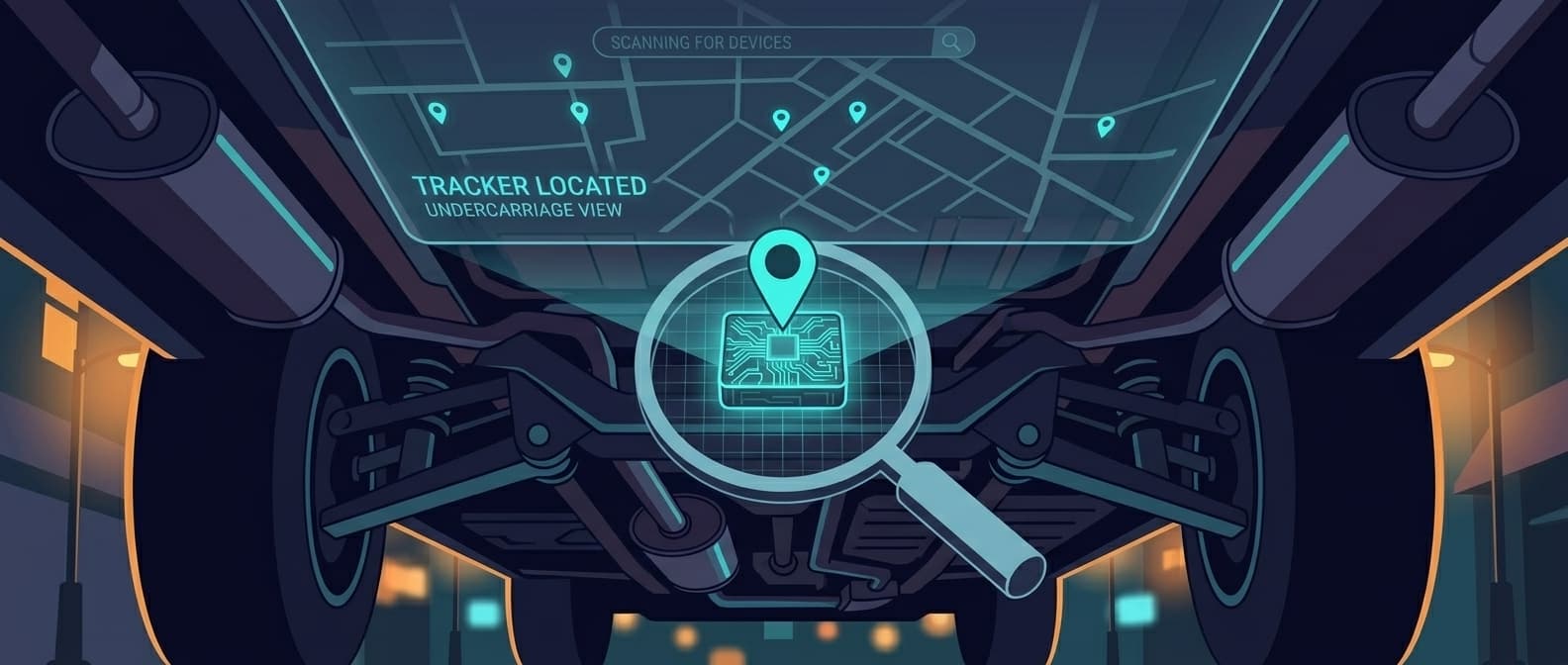
Where Dealerships Hide GPS Trackers (And Why Fleet Buyers Should Care)
Every Buy Here Pay Here dealership in the United States installs GPS trackers on vehicles before handing over the keys. This is not speculation. It's a condition of financing. The devices are manufactured by companies like PassTime, Ituran, Spireon, and CalAmp, and they're installed in the service bay during pre-delivery inspection.
Many franchise dealerships do the same, especially on subprime and deep-subprime loans. Some luxury dealerships install trackers on leased inventory. If you've purchased fleet vehicles in the last five years, from auction, off-lease, or direct from a dealer, there's a meaningful probability that some of them still have active dealer-installed GPS trackers transmitting location data to a third party you don't control.
This article covers where those trackers hide, what data they collect, and what fleet managers should do about it.
Why Dealerships Install GPS Trackers
The primary motivation is repossession. Buy Here Pay Here (BHPH) lots finance vehicles in-house to customers with subprime credit (scores below 600). Default rates on BHPH loans run 20-30%, compared to 2-4% at traditional lenders. When a customer stops paying, the dealership needs to find the car fast.
Without a tracker, repossession agents drive routes looking for the vehicle at known addresses. This can take days or weeks. With a GPS tracker, the dealer pulls up a map, sees the vehicle is parked at a Walmart at 2 AM, and dispatches the repo agent. Recovery time drops from weeks to hours.
The financial incentive is obvious. A BHPH dealer carries 200-500 active loans at any given time. Each vehicle represents $8,000-$20,000 in financed inventory. If 25% default, that's 50-125 vehicles to recover per year. At $300-$500 per professional repossession, plus the carrying cost of a delinquent loan, GPS trackers pay for themselves on the first recovery.
Beyond repossession, dealers install trackers for:
- Starter interrupt. Many dealer-installed units can remotely disable the vehicle's starter. Miss a payment, and your car won't start. PassTime's GPS+ and Ituran's devices both support this.
- Insurance requirements. Some subprime auto lenders require GPS tracking as a condition of the dealer's floor plan financing.
- Lot management. Dealers track their own inventory on the lot, including test drive vehicles that leave the property.
- Speed and geofence monitoring. Some devices report when the vehicle exceeds speed thresholds or leaves a predefined geographic area.
The 12 Most Common Hiding Spots
Dealer-installed trackers follow predictable patterns. Installers have 15-30 minutes per vehicle during PDI (pre-delivery inspection), so they favor locations that are quick to access, hard for the buyer to find, and close to a power source for hardwired units.
1. OBD-II Port (Under the Dashboard)
The most common location. OBD-II plug-in trackers from Zubie, Bouncie, and several dealer-specific brands snap directly into the diagnostic port under the steering column. No wiring required. The device draws power from the OBD port and transmits via cellular. This is the first place to check because it takes zero installation skill.
2. Behind the Dashboard Panel
Hardwired units get tucked behind the dashboard trim panel, typically on the driver's side. The installer removes the lower dash panel (usually 3-4 screws or clips), connects the tracker to a 12V ignition wire and ground, and replaces the panel. The device sits between the firewall and the dash, invisible unless you pull the panel.
3. Inside the Front Bumper
The front bumper fascia has cavities behind the plastic that fit a tracker easily. Battery-powered magnetic units attach to the metal bumper reinforcement bar. Hardwired units can tap into fog light or turn signal wiring. You'll need to get underneath the vehicle or feel inside the gap between the bumper cover and the body.
4. Behind the Rear License Plate
The license plate bracket on many vehicles has enough space behind it to conceal a small tracker. Some magnetic units attach to the metal body panel directly behind the plate. Remove the plate and bracket (4 screws) to inspect.
5. Inside the Wheel Wells
Both front and rear wheel wells offer concealment behind the plastic fender liner. Magnetic trackers attach to the metal body structure inside the well. Pull back the fender liner and feel along the inner fender surface. This is a favorite spot for repo trackers because it's accessible from outside the vehicle.
6. Under the Front and Rear Seats
Hardwired trackers sometimes get mounted to the seat frame rail or the floor pan under the front seats. The wiring runs along the carpet edge to the center console or kick panel, where it taps into the vehicle's harness. Slide the seats fully forward and back, then look underneath with a flashlight.
7. Inside the Door Panels
Less common for dealer installs but used by some. The interior door panel removes with a few clips and screws, exposing a cavity large enough for a tracker. Wiring can tap into the door's power feed. Check all four doors if you suspect a thorough installation.
8. Behind the Glove Box
The glove box drops down or removes entirely with two screws on most vehicles, exposing the HVAC blower area and the main wiring harness. Trackers here get power easily and stay hidden behind a component the owner rarely removes.
9. Near the Spare Tire
In SUVs and sedans with a trunk-mounted spare, the spare tire well provides a large concealment area. Battery-powered trackers can sit under the carpet, on top of or beside the spare. In trucks, check under the bed-mounted spare.
10. Inside the Engine Bay Fuse Box
The main fuse box in the engine compartment has extra space inside the cover or behind the box itself. Some installers mount the tracker inside the fuse box lid or zip-tie it to the fuse box housing. Power is trivially easy to tap. Open the fuse box cover and inspect around and behind it.
11. Behind the Center Console
The center console between the front seats hides wiring for USB ports, heated seats, and the parking brake. A tracker fits easily inside, mounted to the tunnel with zip ties or adhesive. Removing the center console requires more disassembly (8-12 screws on most vehicles), which is why it's a favorite spot for devices the dealer doesn't want found.
12. Hardwired Into the Vehicle's Electrical System
This isn't a location, it's a method. Professional dealer installs hardwire the tracker into the vehicle's 12V system, typically splicing into the ignition wire (for on/off detection), a constant 12V feed, and ground. The device can be mounted anywhere along the wiring harness. The wire splices are the giveaway: look for non-factory wire taps, T-taps, or solder joints in the driver's side kick panel, behind the dash, or under the center console.
What These Trackers Can See
Dealer-installed GPS trackers are not basic location pingers. Modern units from PassTime, Spireon (Kahu), and Ituran collect and transmit:
| Data Point | Collected? | Notes |
|---|---|---|
| Real-time GPS location | Yes | Updates every 30 seconds to 5 minutes |
| Location history (30-365 days) | Yes | Stored on the provider's cloud servers |
| Vehicle speed | Yes | Often with configurable speed alerts |
| Engine on/off events | Yes | Tracks every start and stop |
| Geofence entry/exit | Yes | Alerts when vehicle crosses a boundary |
| Battery voltage | Yes | Detects disconnection attempts |
| Starter interrupt capability | Some | Can remotely prevent engine start |
| OBD-II diagnostic codes | Some | Plug-in units can read check engine codes |
| Odometer / trip distance | Some | Through OBD-II connection |
The data is stored on third-party servers. PassTime stores data on their cloud platform. Spireon stores on theirs. The dealership, or whoever has account access, can view this data remotely through a web portal or mobile app.
When the loan is paid off and the vehicle changes hands, that data doesn't automatically stop flowing. The tracker continues transmitting until someone physically removes it or the cellular subscription lapses.
The Fleet Manager Problem
You run a plumbing company. You just bought 15 used Ford Transit vans at auction to expand your fleet. Eight of them came from a BHPH dealer's repossession pipeline. Three came from a fleet leasing company. Four were off-lease returns from a franchise dealer.
Of those 15 vans, there's a reasonable chance that 6-10 of them have dealer-installed GPS trackers still in place. Some may still be actively transmitting to the original dealer or financing company. Others may have expired cellular subscriptions but could be reactivated.
This creates three problems:
1. Data leakage. A third party you've never spoken to can see where your fleet vehicles go, when they're parked, and where your employees work. For a service business, that's your customer list mapped in real time. A competitor who buys that data (or a dealer employee who sells access) knows every job site you visit.
2. False security. You installed your own GPS trackers on every van. You think you have complete visibility. You don't know that each van also has a second tracker you didn't authorize, creating a parallel data stream you don't control.
3. Legal liability. If you're tracking employees with your own system, you've (hopefully) gotten consent and followed state privacy laws. But the dealer's tracker is also collecting location data on your employees. If that data gets breached or misused, the liability questions get complicated fast.
Is Dealership Tracking Legal After the Loan Is Paid Off?
Short answer: no. But enforcement is effectively nonexistent.
When a vehicle is financed through a Buy Here Pay Here lot or subprime lender, the GPS tracker installation is typically disclosed in the financing agreement. Buried in the paperwork, there's usually a clause authorizing the dealer to install and monitor a GPS device as a condition of the loan. This is legal in all 50 states as long as the borrower consents. And they always consent, because without signing, they don't get the car.
Once the loan is satisfied, that consent expires. The tracker should be removed or deactivated at payoff. In practice, this rarely happens. Dealers manage hundreds of active tracker accounts. They don't have a systematic process for deactivation at payoff. Many simply leave the device in place until the cellular subscription expires, which can take 1-3 years depending on the provider's billing cycle.
If the vehicle is sold to a new owner, the dealer has no tracking authorization whatsoever. The new buyer never signed a consent form. Continued tracking at that point likely violates state electronic surveillance laws. California Penal Code 637.7 makes it a misdemeanor to use an electronic tracking device to determine the location of a person without consent. Similar statutes exist in Texas, Virginia, New York, Florida, and most other states.
The FTC has taken action. In 2022, the FTC ordered a major auto dealer group to stop secretly tracking consumers after vehicle purchases. The order included a prohibition on misusing personal data collected through GPS trackers.
In practice, nobody enforces this. Buyers don't know the tracker exists. If they find one, they throw it away. Nobody files a complaint. The dealer faces zero consequences for leaving trackers active on vehicles they no longer finance.
For fleet buyers purchasing used vehicles, this means you should assume every vehicle has a potential tracker until proven otherwise.
How to Find and Remove Dealer Trackers
A systematic sweep of every acquired vehicle takes 30-60 minutes per vehicle. For a fleet purchase of 10+ vehicles, this is a worthwhile investment.
Physical Inspection Checklist
Work through the 12 hiding spots listed above in order. You need:
- Flashlight (LED, high lumen, the brighter the better)
- Trim removal tools (plastic pry set, $10-$15 on Amazon)
- Socket set (to remove bumper bolts and console screws)
- Inspection mirror (telescoping, for seeing behind the dashboard and under seats)
What you're looking for:
- Any device that isn't factory-installed. Dealer trackers are typically small black boxes (2"x3"x1"), sometimes with a visible antenna stub or LED indicator.
- Non-factory wiring. Look for wire taps (T-taps), electrical tape over splices, or wires that run to a device rather than a factory connector.
- Magnetic devices attached to metal body panels. Run your hand along metal surfaces inside wheel wells, behind bumpers, and under the vehicle.
- Anything plugged into the OBD-II port that isn't a diagnostic tool or insurance dongle.
RF Detector Sweep
A handheld RF (radio frequency) detector picks up the cellular signal that GPS trackers use to transmit data. These cost $30-$100 and work by detecting the 2G/3G/4G signal burst when the tracker reports its location.
How to use one:
- Park the vehicle in a quiet area away from cell towers and other electronics.
- Turn off your phone and any Bluetooth devices.
- Slowly sweep the detector over the dashboard, under the seats, inside the wheel wells, along the bumpers, and under the vehicle.
- Most trackers transmit on a schedule (every 30 seconds to 5 minutes). You may need to wait and sweep multiple times.
- A signal spike in a specific area indicates a transmitting device.
Budget RF detectors won't catch devices in sleep mode or those using infrequent reporting intervals. Professional-grade detectors ($200-$500) are more sensitive and can differentiate between signal types.
OBD-II Port Scan
Plug-in OBD-II trackers are the easiest to find. Look at the port (under the steering column, driver's side). If there's anything plugged in that you didn't put there, remove it. Some OBD devices are small enough to barely protrude from the port, so look carefully.
If you want to check whether the OBD port has been modified to provide power to a hidden tracker, use an OBD-II scanner to check for non-standard PIDs or unusual communication patterns.
Professional Sweep ($200-$500 per vehicle)
For high-value fleet acquisitions, professional technical surveillance countermeasures (TSCM) firms will do a comprehensive electronic sweep. They use non-linear junction detectors (NLJDs) that can find electronic components even when they're powered off, plus spectrum analyzers that identify transmitting devices across all frequencies.
This is overkill for a $15,000 used van. It makes sense for executive vehicles or situations where competitive intelligence is a concern.
Why Every Fleet Manager Should Audit Acquired Vehicles
A tracker audit should be standard operating procedure for every vehicle entering your fleet. The cost is minimal. The risk of not doing it is real.
Build it into your onboarding process:
- Pre-delivery inspection. Before a new acquisition enters service, allocate 30-45 minutes for a tracker sweep. Train one technician on the 12-spot checklist above.
- Document findings. Photograph any devices found, note the manufacturer and model, and record the VIN of the vehicle. This creates a record if legal questions arise later.
- Remove and dispose. Disconnect hardwired trackers by removing the wire taps and insulating the factory wiring. For plug-in OBD devices, unplug and discard. For magnetic battery-powered units, remove and discard.
- Check the battery. Hardwired trackers sometimes include a backup battery that allows the device to transmit for 24-72 hours after disconnection. If you remove a hardwired unit, expect a brief period where it may still report its last known location.
- Notify the source. If you purchased the vehicle from a dealer, inform them that you found and removed their tracking device. Some dealers will voluntarily deactivate the account. Others won't respond. Either way, you've established a paper trail.
Replace Dealer Trackers With Your Own System
Once you've cleared third-party trackers from your fleet, you need visibility over your vehicles under a system you control.
This is where fleet managers have two options: traditional cellular GPS trackers ($20-$40/month per vehicle) or Apple AirTag-based tracking through a platform like Airpinpoint.
The economics differ significantly:
| Cellular GPS Tracker | AirTag + Airpinpoint | |
|---|---|---|
| Hardware cost per vehicle | $80-$150 | $29 (AirTag) |
| Monthly cost per vehicle | $20-$40 | $11.99 (Business) |
| Installation | Hardwired or OBD-II | Place in vehicle, no wiring |
| Update frequency | 30-60 seconds (wired/powered); ~1/day on battery to hit "3-year" battery claims | Every 1-5 min in populated areas |
| Battery | Vehicle-powered (wired) or battery (replaced every 1-5 weeks at useful update rates) | CR2032 coin cell, 12+ months at full update rate |
| Geofence alerts | Yes | Yes (via Airpinpoint) |
| Can be detected by RF sweep | Yes (cellular transmissions) | No (BLE, not cellular) |
| Monthly contract | Usually 1-3 year commitment | Month-to-month |
For fleet managers who need second-by-second location data, cellular GPS is the right choice. For fleet managers who need to know where 15-50 vehicles are parked, when they leave job sites, and whether they're within authorized areas, AirTag-based tracking through Airpinpoint delivers 90% of the value at 10% of the cost.
One nuance on the battery row: battery-powered cellular GPS trackers advertise multi-year battery life by updating roughly once per day. At that rate a "3-year" battery holds about 1,100 total location updates. An AirTag running through Apple's billion-device Find My network delivers that many updates in under three days, then keeps going for 12+ months. If you're replacing dealer trackers on unpowered assets (trailers, equipment), cellular GPS forces a choice between long battery life and useful update frequency. AirTag-based tracking is the only option that gives you both.
Airpinpoint adds the fleet management layer that standalone AirTags lack:
- Geofence alerts. Draw boundaries around your lot, job sites, or service areas. Get notified when any vehicle enters or leaves.
- Multi-vehicle dashboard. See all your vehicles on one map. No switching between Apple IDs or individual Find My instances.
- Location history. Review where each vehicle has been, with timestamps. Useful for verifying time sheets, billing, and route compliance.
- Team access. Multiple dispatchers and managers can view the fleet without sharing a personal Apple ID.
Start a free trial and get your fleet on a tracking system you actually control.
The Data Security Angle
Dealer GPS tracker data has been compromised, sold, and subpoenaed in ways that should concern any fleet operator.
Data breaches. In 2019, a security researcher found that Spireon's tracking platform had vulnerabilities that exposed the real-time location data of over 15 million vehicles. The data included GPS coordinates, VINs, and account information. Spireon patched the vulnerabilities after disclosure, but the incident revealed how much data these platforms hold and how little security scrutiny they receive.
Data broker sales. Location data from vehicle trackers has been sold to data brokers, law enforcement agencies, and marketing firms. A 2020 Vice investigation found that vehicle location data from multiple tracking providers was available for purchase with minimal verification. If your fleet vehicles still have active dealer trackers, your operational patterns may already be in a data broker's database.
Law enforcement subpoenas. GPS tracker data is routinely subpoenaed in criminal investigations, civil lawsuits, divorce proceedings, and insurance disputes. If a dealer's tracker is still active on your fleet vehicle and that data gets subpoenaed in a case involving the previous owner, your vehicle's location history could be dragged into a legal proceeding you have nothing to do with.
Employee privacy. Several states require employers to notify employees before tracking them with GPS. If your fleet has undisclosed dealer trackers collecting employee location data, you may be technically in violation of state notification requirements, even though you didn't install the trackers yourself.
Checklist: Fleet Vehicle Tracker Audit
Use this for every vehicle entering your fleet:
- Check OBD-II port for plug-in devices
- Inspect behind lower dashboard panel (driver's side)
- Check inside front bumper cavity
- Remove and inspect behind rear license plate
- Feel inside all four wheel wells behind fender liners
- Look under front and rear seats
- Inspect inside all door panels (if time permits)
- Drop glove box and inspect behind it
- Check spare tire well / under-bed spare area
- Open engine bay fuse box and inspect around/behind it
- Remove center console screws and inspect inside
- Trace visible wiring for non-factory splices
- Run RF detector sweep (optional but recommended)
- Document findings with photos and VIN
- Install your own tracking (AirTag + Airpinpoint)
Bottom Line
If you're buying used vehicles for your fleet, especially from auction, repo sales, or BHPH lots, assume they have trackers installed. Budget 30-45 minutes per vehicle for inspection. Remove anything you find. Then install your own tracking system so you have visibility under your control, not someone else's.
The dealer's tracker was installed to protect their financial interest. Once you own the vehicle, that interest is gone. But the hardware, the data stream, and the third-party access often remain. Take control of it before someone else's tracking system becomes your liability.
Apple stops at 32 AirTags per account
Airpinpoint tracks unlimited tags in one dashboard, with location updates about every 5 minutes, geofence alerts, and a REST API, from $11.99 per tag per month.
Free to start. Works with the AirTags you already own. 6,700+ tags under management.
